

Five management options proposed for the Colorado River
The Bureau of Reclamation has proposed five options for managing the water taken from the Colorado River. Several of the schemes would involve cutting back the amount of water taken in dry years starting from 2027. However, there is an impasse between upper basin and lower basin states on many of the details.
Decisions that will affect 40 million people
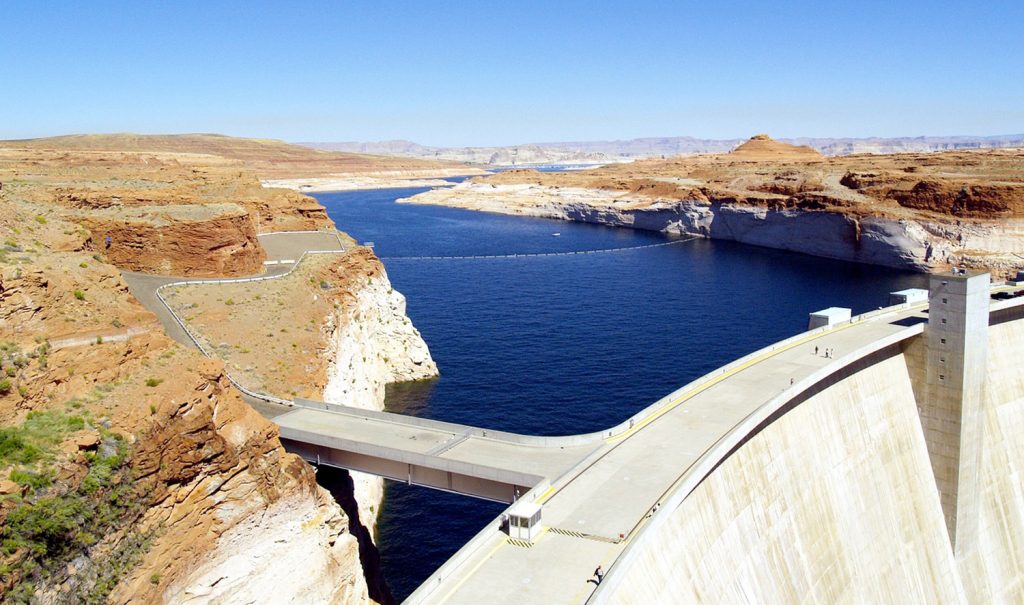
The federal response is designed to meet the challenges of managing the overstressed Colorado River Basin once the current 2024-2026 process has ended. This was instigated following a two-year period, 2021 and 2022, that saw the water levels in Lake Powell and Lake Mead drop to historic lows.
Together, these lakes account for almost 90% of the basin’s storage capacity, and so the federal government at the time needed a scheme to protect local economies, public health, recreation, electric systems, agriculture, the environment, 30 Native American tribes, part of Mexico, seven states, and the 40 million people that rely on the Colorado River for water.
The five schemes explore various strategies that include imposing large cuts on certain states and some that aim to remove the requirement that water is released from Lake Powell regardless of how much water it has collected over the course of a year, one of factors that led to the need for water management in the first place.
Proposed cuts lead to negotiations grinding to a halt
Credit: Brigette Werner/Pixabay
“We’ve been laser-focused on the post-2026 guidelines,” acting deputy secretary of the Interior Laura Daniel-Davis, told media at the launch of the proposals. “It’s really not easy. Building consensus never is.”
Negotiations between the basin states have stumbled on key issues such as which states need to cut water use and by how much during periods of low river flow. Other issues have included which reservoirs are included in the basin management schemes and how long the new rules should last.
The Bureau of Reclamation has proposed five options for managing the water taken from the Colorado River. Several of the schemes would involve cutting back the amount of water taken in dry years starting from 2027. However, there is an impasse between upper basin and lower basin states on many of the details.
Decisions that will affect 40 million people
The federal response is designed to meet the challenges of managing the overstressed Colorado River Basin once the current 2024-2026 process has ended. This was instigated following a two-year period, 2021 and 2022, that saw the water levels in Lake Powell and Lake Mead drop to historic lows.
Together, these lakes account for almost 90% of the basin’s storage capacity, and so the federal government at the time needed a scheme to protect local economies, public health, recreation, electric systems, agriculture, the environment, 30 Native American tribes, part of Mexico, seven states, and the 40 million people that rely on the Colorado River for water.
The five schemes explore various strategies that include imposing large cuts on certain states and some that aim to remove the requirement that water is released from Lake Powell regardless of how much water it has collected over the course of a year, one of factors that led to the need for water management in the first place.
Proposed cuts lead to negotiations grinding to a halt
Credit: Brigette Werner/Pixabay
“We’ve been laser-focused on the post-2026 guidelines,” acting deputy secretary of the Interior Laura Daniel-Davis, told media at the launch of the proposals. “It’s really not easy. Building consensus never is.”
Negotiations between the basin states have stumbled on key issues such as which states need to cut water use and by how much during periods of low river flow. Other issues have included which reservoirs are included in the basin management schemes and how long the new rules should last.
It’s really not easy. Building consensus never is
To be ready by 2027, the states would need to agree on which proposal to move forward with by August 2026.
In a statement prepared for local media, US Senator John Hickenlooper, a Colorado Democrat, said: “These proposed alternatives underscore how serious a situation we’re facing on the Colorado River. The only path forward is a collaborative, seven-state plan to solve the Colorado River crisis without taking this to court. Otherwise, we’ll watch the river run dry while we sue each other.”
Summary of proposed management schemes
Will Sarni, water and nature practice lead at Earth Finance, and Water United founding member, summarised the proposed schemes in a post on his LinkedIn page:
“Alternative 1, would stick closely to the current rules. Under this plan, Lake Powell could release anywhere from 5 million to 9.5 million acre-feet [approximately, the annual water use of two to three households] down to the Lower Basin states ¬- Arizona, California and Nevada. Other reservoirs, like Blue Mesa in Colorado, might be called on to help with these releases, and the Lower Basin could have to cut its use by up to 3.5 million acre-feet.”
“Alternative 2 would require all basin states, even Colorado, to conserve water during times of shortage and it would involve multiple federal reservoirs, like Blue Mesa, the largest reservoir in Colorado. Upper Basin officials from Colorado, New Mexico, Wyoming and Utah argue they should not have to conserve water because the states already use less than their full share of the river. They also say the new management rules should only include lakes Mead and Powell.”
However, the Lower Basin states argue that every stakeholder should make cuts in times of shortage and that reservoirs across the basin should be used to calculate how much water is available. This option also includes explicit accounting of unused and undeveloped water supplies allocated to the 30 Tribal nations in the basin, which have rights to about 25% of the Colorado River.
Sarni continued: “Alternative 3 incorporates ideas from conservation organizations. Under this option, Lake Powell could release more water: Its maximum releases could reach 11 million acre-feet, which is higher than the 9.5 million acre-feet listed in other options. This proposal also includes basin-wide cutbacks, including more conservation in the Lower Basin – a maximum of 4 million acre-feet compared with 3.5 million acre-feet included in other alternatives.”
Talking of the fourth scheme, Sarni added: “Alternative 4 aims to blend competing proposals submitted by upper and lower basin states and tribal nations. Under this draft alternative, Lake Powell might be required to release 12 million acre-feet and to pull water from upstream reservoirs depending on the conditions in the basin. This alternative includes provisions to ensure tribal nations will be involved in water management. It calls for basin-wide cutbacks when water is short and calls for less Lower Basin conservation – maximum cutbacks are listed as 2.1 million acre-feet.”
Related content
https://water-united.com/what-is-the-1922-colorado-river-compact/
https://water-united.com/americas-lifeline-why-the-colorado-river-basin-is-critical/
https://water-united.com/catalytic-communities-and-commercial-value-impact-at-speed/